 MyCigar

1. Pick the right room
A spare bedroom, den or finished garage with an outside wall makes exhaust easy. Watch for spaces that share air with the rest of the house: basements and garages are often open to the house through a stairwell or a shared HVAC return, which pulls smoke everywhere.[1] If you can, choose a room you can close off with its own door.
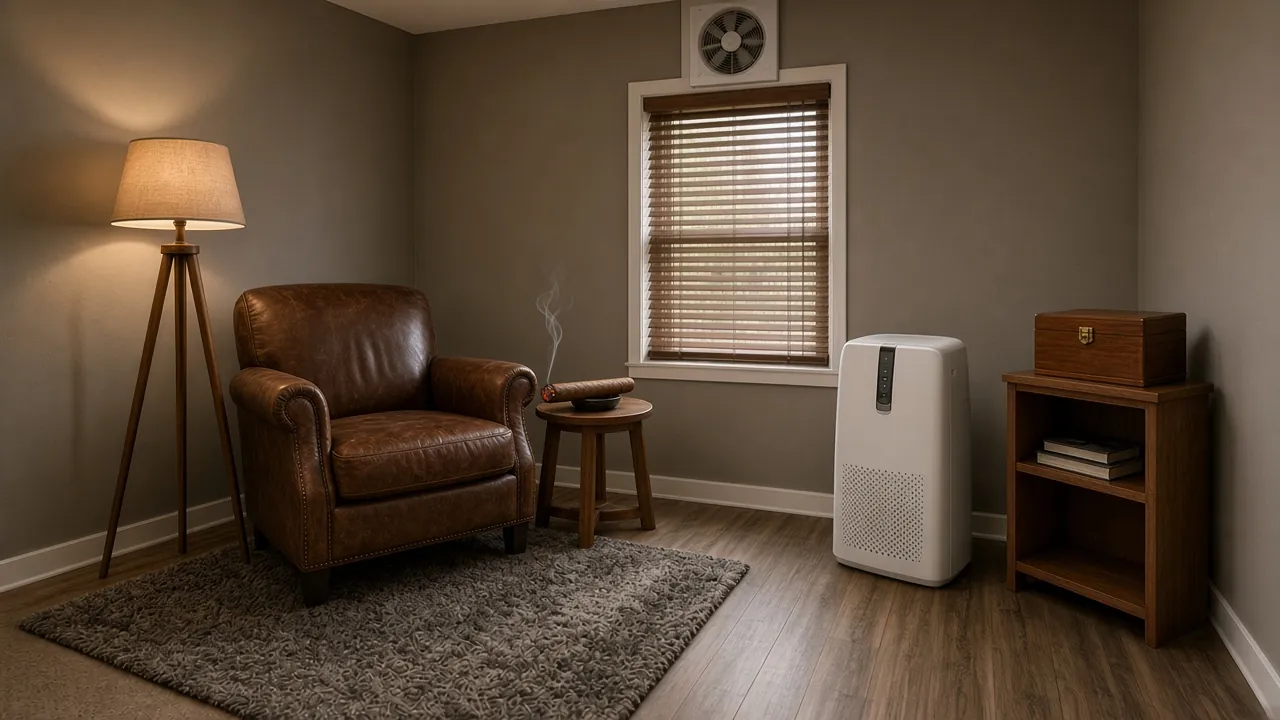
2. Seal it and set the pressure
Smoke follows air pressure. The goal is air moving into the cigar room from the house, never out. Keep the door closed while smoking and weatherstrip the frame, leaving a controlled gap at the bottom so replacement air can enter.[1] LakeAir's contractor guide calls this containment and negative pressure, and notes that a well-placed sealing effort is usually enough for a system to work well.[2]
3. Ventilate: exhaust plus a carbon purifier
A small exhaust fan ducted outside removes live smoke; a carbon purifier handles the lingering smell.[1] Size both with our ventilation sizing guide and compare units on the smoke eater shortlist.
- Put purifiers where people smoke, out in the open, not behind furniture. Spread units out in larger rooms.[1]
- Run purifiers on low all the time and turn them up during and after smoking.[1]
- Close or filter any return-air grille in the room so the central HVAC doesn't carry smoke to the rest of the house.[1]
- For a hidden system, LakeAir's ducted and recessed units sit in an adjacent space or inside the wall; its wall unit needs a framed 21.375 in opening, which means cutting at least one stud.[2]
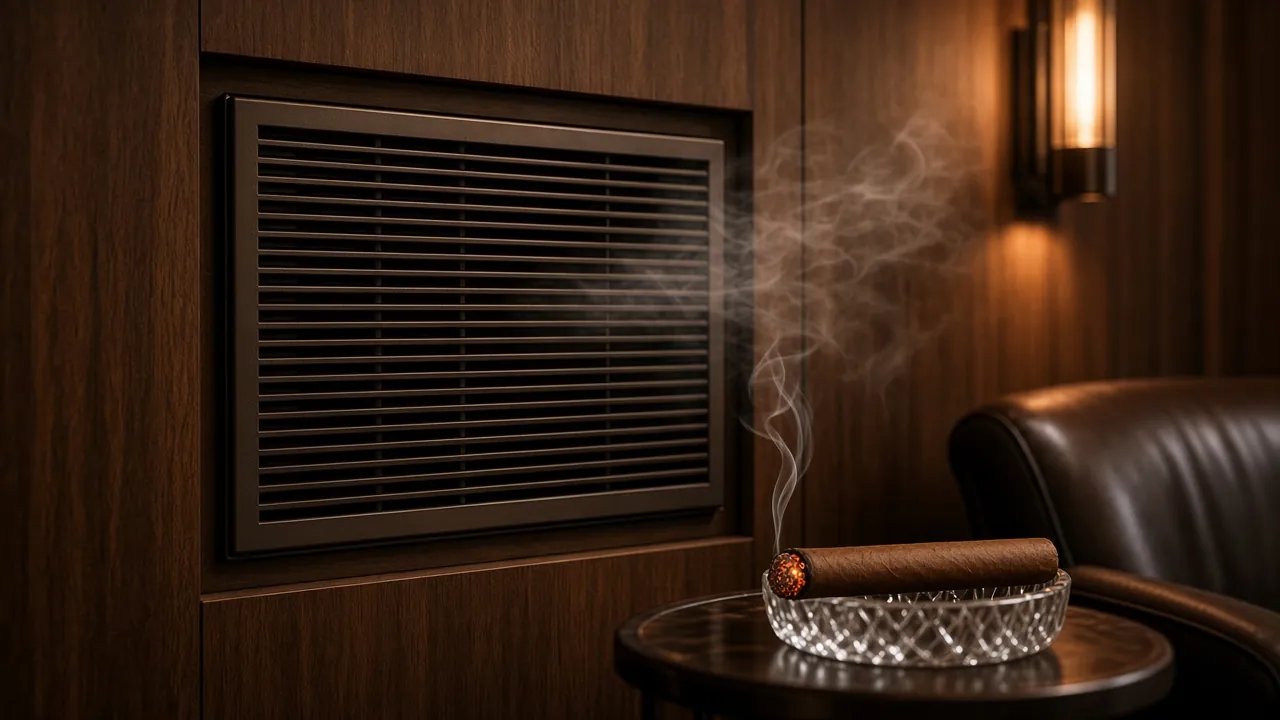
Commercial Air Purifiers publishes a longer blueprint for a professionally ventilated home cigar room if you want more depth.[3]
4. Choose surfaces that don't hold smell
Leather, wood, tile and blinds hold far less smell than carpet, curtains and fabric sofas; CubanVault calls this the cheapest odor control there is.[1] EPA adds that smoke chemicals build up on hard surfaces and embed in soft ones like upholstery, drapes and carpet, and can be released back into the air later.[4] That's a good argument for a leather chair, a wood or tile floor and wipeable walls.
5. Store cigars properly: humidor basics
- Targets: Cigar Aficionado recommends about 70% relative humidity and 68–70°F; its humidor guide gives 68–70°F and 70–72% humidity.[5, 6]
- Too warm or wet invites beetles. Tobacco beetle larvae hatch above 72°F and 72% humidity.[5]
- Use distilled water in the humidifier; tap-water minerals clog it.[7]
- Trust a digital hygrometer. Analog dials are often inaccurate; digital ones are usually within about ±2%.[7]
- Keep it out of sun and away from air conditioners or radiators.[7]
Humidors that fit a cigar room
| Humidor | Style | Price | Link |
|---|---|---|---|
| Quality Importers Old World, 100 cigars | Desktop | $104.99 at Walmart (seller Cigar Warehouse)[8]; $131.99 at Northwoods Humidors[9] prices as of Nov 2026 | Northwoods → |
| Prestige Clevelander, 250 cigars | Electric cabinet | $398 price as of Nov 2026 at CubanVault | CubanVault → |
| Prestige Import Group Belmont, 600 cigars | Table / furniture | $549 price as of Nov 2026 at CubanVault | CubanVault → |
| SensorPush HT.w smart temperature/humidity sensor | Hygrometer | $69.99 price as of Nov 2026 at Northwoods Humidors[10] | Northwoods → |
6. Furniture and lighting
Furniture-style humidors, such as table and cabinet humidors, double as furniture and suit the room theme. For seating, the surface advice above points to leather and wood over fabric.[1]
Build checklist
- Choose a closable room, ideally with an outside wall.
- Seal the door frame, leave a controlled gap at the bottom, and close or filter any HVAC return.
- Install a small exhaust fan ducted outside, high on the far wall.
- Add a carbon purifier sized for your ACH target, with a margin.
- Choose leather, wood, tile and blinds over fabric and carpet.
- Set up a humidor at about 70% / 70°F with a digital hygrometer.
Sources
All sources accessed November 15, 2026. Prices change; check the seller before buying.
- CubanVault, “Cigar Room Ventilation: How Many CFM You Need and How to Size a Smoke Eater” (updated Oct 26, 2026). https://cubanvault.com/blogs/guides/cigar-room-ventilation-cfm-smoke-eater-sizing
- LakeAir, “Smoking Rooms: A Contractor's Guide” (Randy Bush, LakeAir). https://www.lakeair.com/smoking-rooms/smoking-room-contractors-guide/
- Commercial Air Purifiers, “The Blueprint: How to Build a Professionally Ventilated Home Cigar Room”. https://commercialairpurifiers.net/blogs/education/the-blueprint-how-to-build-a-professionally-ventilated-home-cigar-room
- U.S. EPA, “Secondhand Tobacco Smoke and Smoke-free Homes”. https://www.epa.gov/indoor-air-quality-iaq/secondhand-tobacco-smoke-and-smoke-free-homes
- Cigar Aficionado, “Fighting Tobacco Beetles”. https://www.cigaraficionado.com/article/fighting-tobacco-beetles-1246
- Cigar Aficionado, “Humidors”. https://www.cigaraficionado.com/article/humidors-7830
- Cigar Aficionado, “Storing Cigars”. https://www.cigaraficionado.com/index.php/article/storing-cigars-7429
- Walmart (seller Cigar Warehouse), Quality Importers Old World desktop humidor. https://www.walmart.com/ip/Quality-Importers-Desktop-Humidor-Old-World/26819961
- Northwoods Humidors, Quality Importers Old World Desktop Humidor, 100 cigars. https://www.northwoodshumidors.com/products/quality-importers-old-world-desktop-humidor-100-cigars
- Northwoods Humidors catalog (SensorPush HT.w and category price ranges). https://www.northwoodshumidors.com/
- ASHRAE letter to the New Mexico House Health Committee (Feb 2, 2023), quoting the ASHRAE Position Document on Environmental Tobacco Smoke. https://www.ashrae.org/file%20library/about/government%20affairs/public%20policy%20resources/ashrae-letter---hb-168.pdf