 MyCigar
- Airflow needed (CFM) = room volume × target air changes per hour ÷ 60.[1]
- Targets differ by source: CubanVault suggests 10+ ACH from a purifier in a dedicated home cigar room; LakeAir's contractor guide starts cigar rooms at 20 ACH.[1, 2]
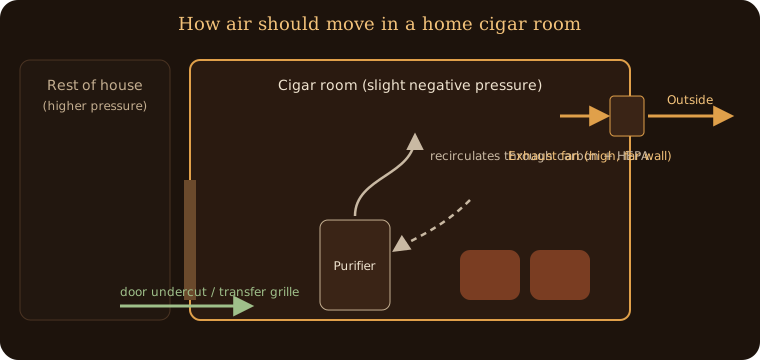
- Pair a carbon purifier with a small exhaust fan, give the room a path for replacement air, and size with a margin, because real airflow is lower than the rating.[1]
Exhaust and purification do different jobs
Exhaust pulls smoky air out of the room and replaces it with air from elsewhere. It is best while people are smoking and keeps smoke from spreading through the house. A purifier cycles the room's air through carbon and HEPA filters. It is best at clearing the haze and smell between and after sessions, but can struggle to keep up with several smokers at once.[1]
LakeAir, which makes ducted and ceiling smoke eaters, describes the better home smoking rooms as working like small commercial lounges: commercial smoke eaters, controlled make-up air and negative pressure.[2]
The math: volume, air changes and CFM
- Room volume = length × width × ceiling height, in cubic feet.
- Air changes per hour (ACH) = airflow (CFM) × 60 ÷ room volume.
- Airflow needed = room volume × target ACH ÷ 60.
These are the formulas CubanVault uses in its sizing guide. It also cautions that real airflow through a deep carbon bed or a long duct run is lower than a fan's maximum rating, and that you won't run a purifier on high all the time, so it recommends a margin of at least 25%.[1]
How many air changes per hour?
| Source | Situation | Target |
|---|---|---|
| EPA portable air cleaner chart | General particle removal; minimum CADR of 65 CFM per 100 sq ft, assuming 8 ft ceilings | About 5 ACH (our arithmetic: 65 × 60 ÷ 800) |
| CubanVault | Occasional cigar in a den | 6+ ACH from a purifier |
| CubanVault | Dedicated home cigar room, regular smoking | 10+ ACH from a purifier, plus an exhaust fan |
| LakeAir contractor guide | “Standard” and “Solid” cigar room settings | 20 ACH of filtration |
| LakeAir contractor guide | “Premium” air quality | 21–25 ACH |
| LakeAir contractor guide | Fresh-air exchange (exhaust plus replacement air) | 1 ACH minimum with very good purification; 3 ACH “best practice” |
Sources: EPA[3], CubanVault[1], LakeAir[2].
EPA's chart is for particles only. EPA notes there is no widely used rating system for removing gases, and that activated carbon filters “can be effective, provided that there is a large amount of material used in the filter.”[3] Cigar smell is largely a gas problem, which is why the carbon weight a manufacturer lists matters as much as CFM.
Airflow calculator
Worked example: a 12 × 12 ft room with an 8 ft ceiling
Volume is 12 × 12 × 8 = 1,152 cubic feet. At 10 ACH you need 1,152 × 10 ÷ 60 = 192 CFM; with a 25% margin, 240 CFM. At LakeAir's 20 ACH you need 384 CFM, or 480 CFM with the margin.
| Unit | Published airflow | ACH in this room at that airflow |
|---|---|---|
| AC Infinity Cloudline S6 (exhaust fan, not a purifier) | 402 CFM[4] | 21 (as exhaust; real airflow through ducting is lower) |
| Smoke Stomper Home | 450 CFM[5] | 23 |
| LakeAir Maxum HEPA-120 | 500 CFM, 490 CADR[6] | 26 |
| Airpura T600 / T600-W | 560 CFM (free flow)[7] | 29 |
| Airpura T700 | 635 CFM[1] | 33 |
| LakeAir LAAS-1600 HOC (ducted) | Up to 1,000 CFM per the product description; spec table lists 400–1,500 CFM capacity[8] | 52 at 1,000 CFM |
CubanVault runs the same room with a T600 and gets about 29 air changes an hour at maximum airflow, so one unit can run on a quieter setting.[1] In a bigger space, such as a 24 × 24 ft garage with 9 ft ceilings (5,184 cubic feet), one T700 manages about 7 air changes an hour, so you would add units or exhaust.[1]
Sizing the exhaust fan
CubanVault suggests a quiet inline fan in the 100–300 CFM range for a typical home cigar room, ducted outside, to create slight negative pressure and remove live smoke.[1] LakeAir's guide frames the same idea as fresh-air exchange: at least 1 ACH with very good purification, and 3 ACH as best practice.[2] For the 12 × 12 ft example, 1 to 3 ACH works out to about 19 to 58 CFM of exhaust (our arithmetic), so a variable-speed fan run low covers it.
- Give the air a way in. A door undercut or transfer grille lets house air replace what the fan removes. Without it the fan moves far less than its rating.[1]
- Exhaust high, on the far side from where fresh air enters, so air sweeps across the seating.[1]
- Keep the house HVAC out of it. Close or filter any return-air grille in the smoking area so the central system doesn't spread smoke.[1]
- Use smooth, rigid ducting where you can. LakeAir notes flexible duct's ridges add friction and reduce airflow.[8]
Filters: carbon, HEPA and MERV
- Carbon removes the smell. CubanVault warns that HEPA-only purifiers clear haze but not smell.[1] Published carbon loads vary a lot: 900 g in the Maxum HEPA-120, 26 lb in the Airpura T600-W, and 2,750 g per filter in the LAAS-1600 HOC.[6, 7, 8]
- HEPA captures fine particles. LakeAir says HEPA is chosen in over 90% of the home smoking rooms it equips.[2]
- MERV 15 is a dust filter. LakeAir says it lets 5–15% more smoke through than HEPA.[2]
- Budget for replacements. Airpura lists the T600-W's carbon filter at 24 months and its tar pre-filter at 6–12 months; LakeAir suggests replacing LAAS-1600 carbon every three to six months.[7, 8] EPA notes any overloaded filter stops working well.[3]
Commercial lounges are a different project
If you're planning a cigar bar or a lounge open to members, ventilation is set by code and your building official, not by a sizing calculator. CubanVault's summary of the International Mechanical Code lists smoking lounges at 60 CFM of outdoor air per person, exhausted and never recirculated, and stresses that local interpretation varies.[1] Talk to a mechanical engineer before you buy anything.
Next steps
Once you know your CFM target, compare units on our smoke eater and purifier shortlist, or read the full home cigar room build guide.
Sources
All sources accessed November 15, 2026. Prices change; check the seller before buying.
- CubanVault, “Cigar Room Ventilation: How Many CFM You Need and How to Size a Smoke Eater” (updated Oct 26, 2026). https://cubanvault.com/blogs/guides/cigar-room-ventilation-cfm-smoke-eater-sizing
- LakeAir, “Smoking Rooms: A Contractor's Guide” (Randy Bush, LakeAir). https://www.lakeair.com/smoking-rooms/smoking-room-contractors-guide/
- U.S. EPA, “Guide to Air Cleaners in the Home”. https://www.epa.gov/indoor-air-quality-iaq/guide-air-cleaners-home
- Home Depot, AC Infinity Cloudline S6 product page. https://www.homedepot.com/p/AC-Infinity-Cloudline-S6-Quiet-6-in-Inline-Duct-Fan-Speed-Controller-Heating-Cooling-Booster-Hydroponics-Grow-Tents-Ventilation-AI-CLS6/318063758
- Get The Smoke Out, Smoke Stomper Home Smoke Eater. https://getthesmokeout.com/products/smoke-stomper-home-smoke-eater
- Commercial Air Purifiers, LakeAir Maxum HEPA-120 product page. https://commercialairpurifiers.net/products/lakeair-maxum-hepa-120
- Airpura, T600-W Tobacco Smoke Wholehouse Air Purifier (product page and spec table). https://www.airpura.com/products/t600-w-tobacco-smoke-wholehouse-air-purifier
- LakeAir, LAAS 1600 HOC product page and specifications. https://www.lakeair.com/product/laas-1600-hoc/
- U.S. EPA, “Secondhand Tobacco Smoke and Smoke-free Homes”. https://www.epa.gov/indoor-air-quality-iaq/secondhand-tobacco-smoke-and-smoke-free-homes
- ASHRAE letter to the New Mexico House Health Committee (Feb 2, 2023), quoting the ASHRAE Position Document on Environmental Tobacco Smoke. https://www.ashrae.org/file%20library/about/government%20affairs/public%20policy%20resources/ashrae-letter---hb-168.pdf